
The thing about my way of teaching stats is that my cool, novel examples get old really fast. Like, pop culture is on a thirty-day cycle. Anyway, YEARS ago, 2014 to be exact, I blogged about illustrating bimodal data distributions using baby name data from the Social Security Administration. Specifically, when an older name comes back into vogue, it has a bimodal distribution when you plot time on the X axis. I stand by this example. However, all of the data illustrations come from 2014. When our traditionally aged college students were 6 or 7. Which makes this example feel a little stale. However, here is some data, courtesy of Redditor fevaah , showing old names that are back in vogue through 2025 ! And Eleanor, Violet, Nora, and Hazel are here, illustrating bimodal distributions for a new generation. If you used my old baby-name data, this is a quick, easy refresh for your lectures (or a fun new addition if you didn't). If this idea was help...
Alright, kismet, coincidence, I don't know. Still, I'm noticing all of these recent and good scientific articles contain the types of statistical analyses we typically teach in Psych Stats.
Like this article:
Hatano, A., Ogulmus, C., Shigemasu, H., & Murayama, K. (2022). Thinking about thinking: People underestimate how enjoyable and engaging just waiting is. Journal of Experimental Psychology: General. Advance online publication. https://doi.org/10.1037/xge0001255
TL;DR: People think they won't enjoy being alone with their thoughts. BUT THEY DO, as the authors demonstrated throughout five experiments. And those experiments contained a bunch of t-tests (and open data). There are even a couple of ANOVAs in there.
This is a fine example of how to flesh out a hypothesis using a multi-study design. And it is a round-about way of making our students (and ourselves) reflect on how we feel about boredom, alone time, and technology.
It also contains some very effective data visualization (and also some effective tables):
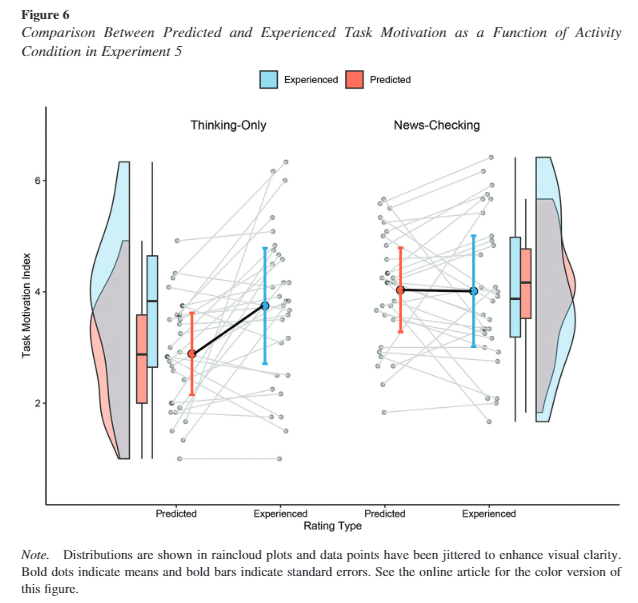 |
| Will you look at that? A simple research design, with a simple t-test, but visualized very well to demonstrate variability. I feel like these participant-by-participant level illustrations are more honest. |
 |
| Maybe data viz. isn't your thing, or what you are teaching a bunch of junior statisticians? No problem, there are also several great tables in this research. |