If you like my blog, why not get updates sent directly to your email? Great ideas for teaching statistics, all delivered to your inbox. Subscribe Powered by Alternately, you could use your own RSS feed using: https://notawfulandboring.blogspot.com/feeds/posts/default?alt=rss
Eric Roston and Blacki Migliozzi put together some great data visualizations illustrating different factors that may or may not contribute to global climate change ("What's Really Warming the World?"). I couldn't capture it in this blog post, but the data is animated and interactive as to highlight change over time. Very slick.
This got me thinking about multiple regression, which studies different variables (X1, X2...) that may or may not contribute to some outcome (Y), and how we can use this website as a conceptual example of multiple regression.

This page can also be used to explain plain old linear regression. This example compares one predictor/X (volcanoes) to one predicted/Y (global temperature).

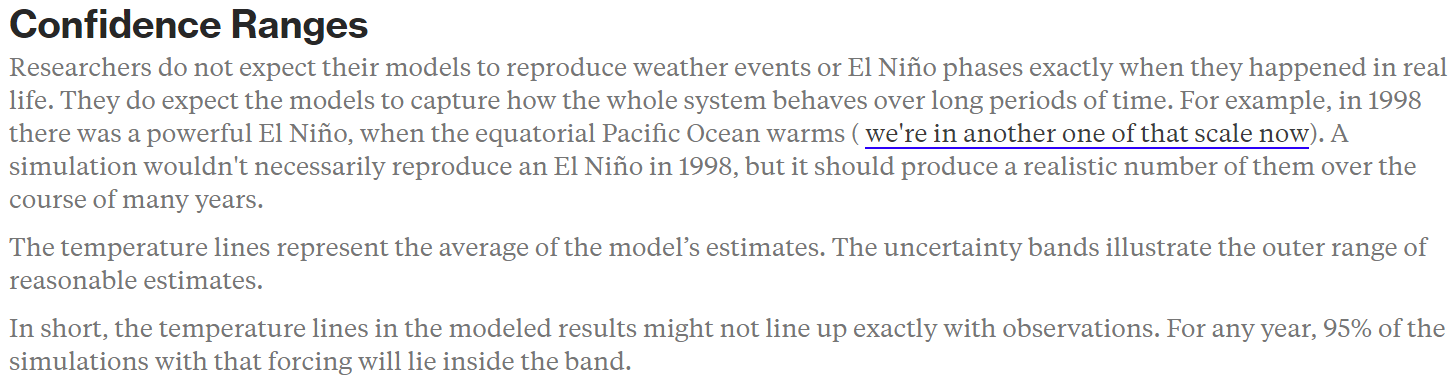
This page also does a great job of explaining the confidence intervals featured in the graphics (see above for the shaded portion for the volcano data).

This got me thinking about multiple regression, which studies different variables (X1, X2...) that may or may not contribute to some outcome (Y), and how we can use this website as a conceptual example of multiple regression.
Here, the graph features multiple "predictor"/X1, X2, X3, X4 variables (greenhouse gasses, ozone, land use, aerosols) as well as the predicted/Y variable (global temperature). we can see the aerosols are likely a very poor predictor while greenhouse gasses are likely a good predictor.

This page can also be used to explain plain old linear regression. This example compares one predictor/X (volcanoes) to one predicted/Y (global temperature).

This page also does a great job of explaining the confidence intervals featured in the graphics (see above for the shaded portion for the volcano data).