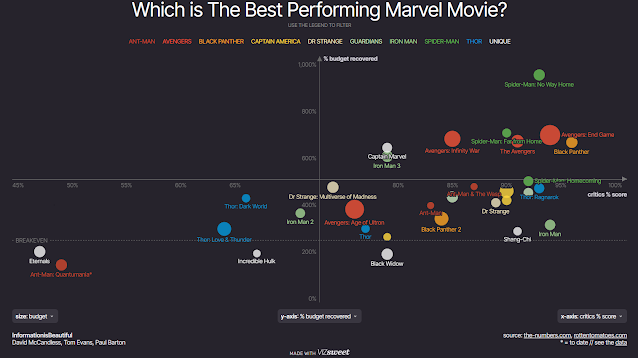
Multiverse = multiple correlation and regression examples!


A scatterplot illustrating data regarding films in the MCU

How to use in class:

1. Experiment with the outcome variables you can add to the X and Y axes: Critical response, budget, box office receipts, year of release, etc. There are more than that; you can add them to either the X or Y axes. So, it is one website, but there are many ways to assess the various films.

2. Because of interactive axes, there are various correlation and regression examples. And these visualizations aren't just available as a quick visual example of linear relationships...see item 3...

3. You can ask your students to conduct the actual data analyses you can visualize because the hecking data is available.

4. The website offers exciting analyses, encouraging your students to think critically about what the data tells them.


5. You could also squeeze Simpson's Paradox example from this data. Sure, you can view the overall trends when you look at all of the movies simultaneously (like the first scatterplot in this blog post). However, you can also look at individual franchises and see differences in performance, like Avengers movies vs. Thor movies (see below).

Scatterplot just for the Avenger's movies

Scatterplot for just the Thor movies


Popular posts from this blog

Ways to use funny meme scales in your stats classes

Have you ever heard of the theory that there are multiple people worldwide thinking about the same novel thing at the same time? It is the multiple discovery hypothesis of invention . Like, multiple great minds around the world were working on calculus at the same time. Well, I think a bunch of super-duper psychology professors were all thinking about scale memes and pedagogy at the same time. Clearly, this is just as impressive as calculus. Who were some of these great minds? 1) Dr.  Molly Metz maintains a curated list of hilarious "How you doing?" scales.  2) Dr. Esther Lindenström posted about using these scales as student check-ins. 3) I was working on a blog post about using such scales to teach the basics of variables.  So, I decided to create a post about three ways to use these scales in your stats classes:  1) Teaching the basics of variables. 2) Nominal vs. ordinal scales.  3) Daily check-in with your students.  1. Teach your students the basics...

Leo DiCaprio Romantic Age Gap Data: UPDATE

Does anyone else teach correlation and regression together at the end of the semester? Here is a treat for you: Updated data on Leonardo DiCaprio, his age, and his romantic partner's age when they started dating. A few years ago, there was a dust-up when a clever Redditor r/TrustLittleBrother realized that DiCaprio had never dated anyone over 25. I blogged about this when it happened. But the old data was from 2022. Inspired by this sleuthing,  I created a wee data set, including up-to-date information on his current relationship with Vittoria Ceretti, so your students can suss out the patterns that exist in this data.

Tyler Vigen's Spurious Correlations

Tyler Vigen has has created  a long list of easy-to-paste-into-a-powerpoint graphs that illustrate that correlation does not equal causation. For instance, while per capita consumption of cheese and number of people who die by become tangled in their bed sheets may have a strong relationship (r = 0.947091), no one is saying that cheese consumption leads to bed sheet-related death. Although, you could pose The Third Variable question to your students for some of these relationships). Property of Tyler Vigens, http://i.imgur.com/OfQYQW8.png Vigen has also provided a menu of frequently used variables (deaths by tripping, sunlight by state) to help you look for specific examples. This portion is interactive, as you and your students can generate your own graphs. Below, I generated a graph of marriage rates in Pennsylvania and consumption of high fructose corn syrup. Generated at http://www.tylervigen.com/